
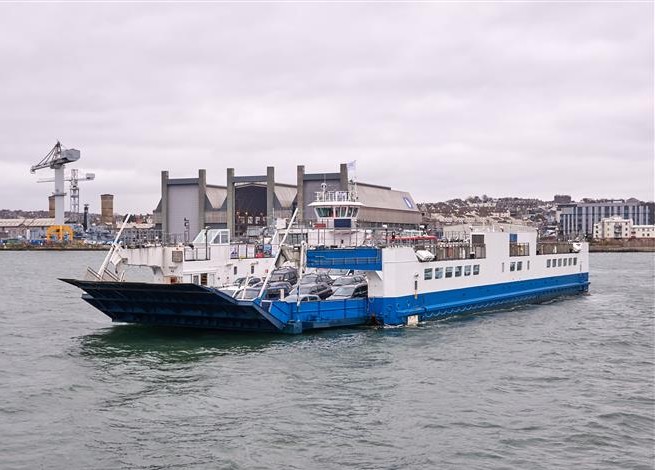
The Torpoint ‘Bridge to Zero’ project has reached a key technical milestone, with the project team identifying five feasible options to replace onboard diesel generation with shore-supplied green electricity for the Torpoint chain ferries.
The project is examining how zero-emission energy systems could be integrated into a high-frequency, 24-hour chain ferry operation, with a focus on maintaining operational reliability.
It is being delivered by Marine Zero, working in partnership with Tamar Crossings and the University of Plymouth, and is developing a fully costed, engineering-ready assessment of decarbonisation options for the ferry service operating across the River Tamar between Devonport and Torpoint.
Operated by Tamar Crossings, Torpoint is the world’s busiest chain ferry service by daily crossings and passenger volume. It carries more than 3 million vehicles and approximately 400,000 pedestrians each year, providing a continuous crossing between Cornwall and Devon.
Energy Transmission Options Under Assessment
Following a feasibility study and review of operational and physical constraints, five energy transmission options have been identified for further assessment:
Hydrogen fuel system
Fixed power cable on reel
Portable battery modules
Automated fast-charging
‘Charge at Anchor’ system
Each option is being assessed for its ability to replace diesel-generated electrical power used by the ferries’ electric propulsion motors, while retaining appropriate operational and resilience arrangements.
Real-Time Operational Data Collection
Marine Zero has installed real-time monitoring equipment across the ferry fleet to collect detailed data on operational power demand and energy use. The data is being analysed jointly by Marine Zero and researchers at the University of Plymouth using computer modelling techniques.
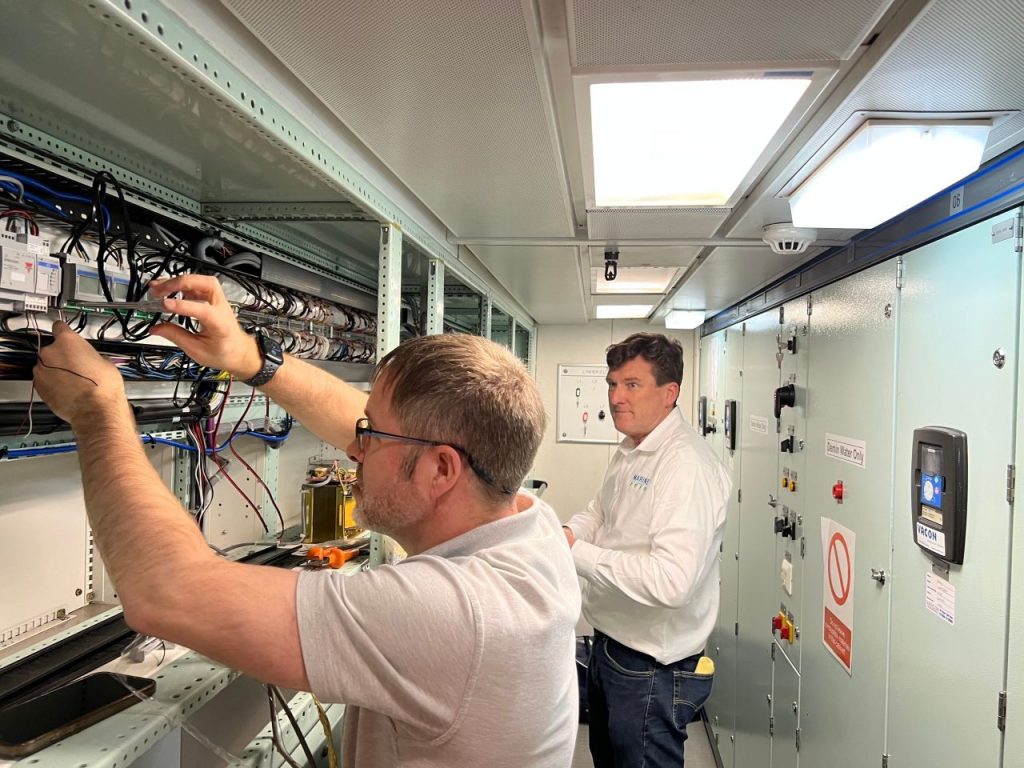
This analysis will inform the next phase of system design and support assessment of how potential solutions could be integrated with existing vessels and operations.
In parallel, the project team is evaluating options for supplementary onboard renewable energy generation, including compact wind turbines. Early modelling indicates that such systems could contribute up to 300 kWh per day, equivalent to approximately 20% of a vessel’s daily energy demand, subject to operational and environmental conditions.
Project Partner Perspectives
Tim Munn, Managing Director of Marine Zero, said:
“Our priority is to identify a decarbonisation solution that protects the reliability and continuity of the service. By analysing real-world operational energy data, we’re generating critical insights that will inform not only the Torpoint Ferry’s transition, but similar services facing the same technical challenges across the UK and beyond.”
Robert Powell, Ferry Engineering Manager for Tamar Crossings, said:
“Overcoming the challenge of integrating multiple sets of live stream data collection equipment into the first of three ferries is a key milestone in the study. For the first time we can fully analyse how the vessel interacts with her operating environment allowing the project to develop robust solutions and justifications for the decarbonise challenge. Whatever form the solution takes, the opportunity to integrate carbon neutral technology into our current fleet provides opportunity for continuous development which will feed into our future vessels and other similar ferry services.”
Dr Lauren Ansell, Lecturer in Data Science at the University of Plymouth, said:
“The data analysis resulting from deploying multiple sensors is enabling us to get a holistic view of the ferry’s operational data in detail. With the ability to uncover where emissions are generated and identifying opportunities for efficiency, we can build a strong evidence base for decisions about low‑carbon technologies.”
Funding and next steps
The Bridge to Zero project is funded by the UK Government through the UK Shipping Office for Reducing Emissions (UK SHORE) programme within the Department for Transport, with Innovate UK, part of UK Research and Innovation, acting as the delivery partner.
Project findings will inform future decision-making on ferry decarbonisation options and will also support longer-term planning for fleet replacement expected from 2034.